That Aged Poorly
The pressure to be the loudest voice in the room has fueled the rise of hot-take culture across sports media. One UF graduate built a social media phenomenon exposing bad predictions, only to bring more attention to the behavior he set out to mock.
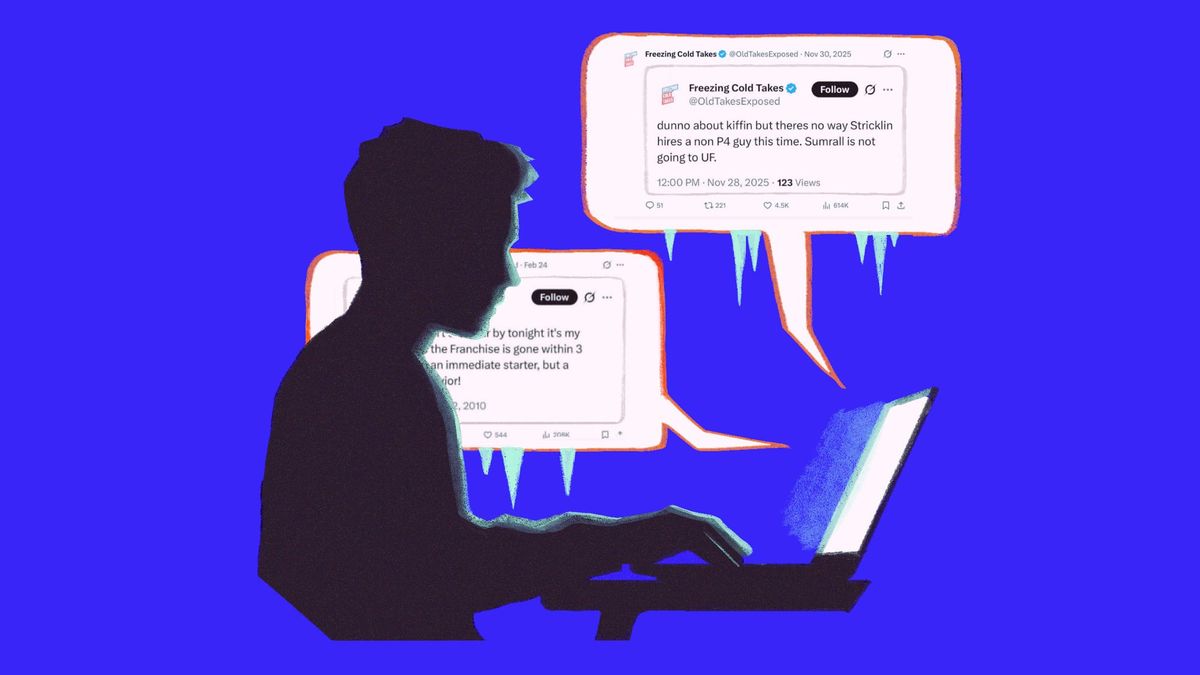
Sinking into his futon, a bit sweaty from the West Palm Beach heat, Fred Segal couldn’t stop laughing. It was one night in 2016, and he and some friends had seen a tweet, back when the app’s name meant that’s what people posted. Back then, it was more of a “forum” and less of a “shouting table,” Segal said. A prominent sportswriter, one of Sports Illustrated’s finest, had fired off an asinine take about the Dallas Cowboys.
It aged poorly. But the writer, obviously, didn’t say a word about his miss. Then a week later, after he unpacked his Twitter fingers once more to shoot off a prediction that the Chicago Cubs would advance to the National League Championship Series, the same writer was making the rounds on the shoulders of those Cubbies, weeks before their historic World Series run.
Segal found it hilarious. Sports media figures have always had a habit of spouting boisterous proclamations, much like any longtime fan sitting in front of the television. They also have something else in common: little interest in the rearview mirror. Your buddy never brings up that time he thought Ben Simmons was the next face of the NBA. Err, wait, maybe that was Colin Cowherd?
On this fall evening, though, Segal had enough. It was time to become a digital vigilante. He’d work in the dark, from a social media profile that his name wouldn’t grace for another five years, identifying and promoting the failed “takes” of sports media members. Soon, his targets expanded to anyone with a following willing to spout something foolish.
Over the next several years, his following burgeoned, from hundreds to thousands to something consistently bubbling above 600,000. But the world he built his platform around has evolved. In the past decade, sports consumption, in a swirl of politics and social media, has become tied directly to the unmitigated, oft-ill-informed, distinctly human term known as “hot takes.” Everyone has a platform and an opinion. Sports TV shows turned even further into talk radio, social media exploded and the culture increasingly rewarded "embrace debate" theatrics and instant-gratification reactions. Segal sits in the middle of it all, wrestling with how, while mocking, he’s helped perpetuate the culture that’s now become a driving force in sports media.
The man behind “Freezing Cold Takes” is a 2003 UF communications graduate whose fascination with the NFL happened to intersect with one of sports media’s famous traditions: sharing bold opinions with unwavering confidence.
What you don’t know, anyway, is what Segal, a watchdog of “take culture,” thinks.
“It’s only been a decade, but I’m never sure how much longer I’ll keep doing this,” he said. “We live in a world where anyone can say anything and shove it in your face. One where you actually benefit from doing that — from being wrong.
“Good god, how dangerously odd that is.”

The meal plates were being handed out to media members, this time before a Florida football game in recent weeks, when Andy Staples and Ari Wasserman struck up a conversation.
“I wonder if this is going to blow up?” Wasserman said to his reporting partner, flashing the first of a string of Nebraska-related tweets he’d fire off in the next hour, all before Nebraska did what the it has done 31 consecutive times against ranked teams: lose.
“You never know,” Staples responded.
In many ways, that interaction is exactly what’s made Segal’s Batman-like social media presence hum. Staples and Wasserman work for On3, a college football-centric site that was founded in 2021, which revved its engine across the college sports landscape through its social media presence.
Its reporters, like Staples and Wasserman, serve a dual purpose — to provide information and analysis, while also grabbing headlines. It’s a labor best executed through quantity. So when watching games, they’ll often find themselves tweeting their subconscious.
“You’re always trying to stay connected to everything,” Wasserman said. “And you need to be a bit reactionary. Journalists are so close to the people now, in some ways they need to make themselves react in the same way.”
Which is quite different from Segal’s pioneer days. Sports journalism originated as a conduit of information. Certainly, the media still connects the fan to the team, the league and the characters who define these entities. But the line between fandom and journalism has blurred. This week, ESPN executive vice president Mike Foss sat on a panel hosted by Front Office Sports and made a bit of a claim. Pat McAfee, one of the Worldwide Leader's most polarizing personalities, is “a journalist at heart,” Foss claimed, but he’s just the most recent in a line of entertainment-first, reporting-second stars across ESPN, Fox Sports and the rest of sports media’s giants.
“That’s utter bs,” Segal said. “But this is where we’ve evolved to.”

In the same vein as On3’s model, most sports media companies, none more than ESPN, have come to understand their value is leaning toward entertainment and personality more than information. Everyone needs to be able to generate clicks, light or heavy news day be damned.
And in that environment, there’s a space for provocative, and sometimes ignorant, statements. Multiple journalists said they’re more inclined to share opinions than in the past. Some media companies have even encouraged their employees to post more audaciously, two media members said, with the understanding that providing “hot takes” is a way of keeping viewers, readers, consumers engaged.
ESPN's Pardon the Interruption, Around the Horn and First Take helped popularize sports television opinion shows, following in the footsteps of sports radio, which had been spreading bold proclamations on folks' drives to work for the better part of 50 years.
Social media just opened the floodgates. Anyone could share any thought in real time, and people feel more inclined to challenge it when hiding behind an avatar.
“It made it so easy for people to just say things, and if they were right, they’d proclaim their brilliance everywhere,” Segal said. “But when they were wrong, it would just disappear and they’d post the next 1,000 things.”
So Segal took up his post. Rapidly, personalities caught on.
“It’s hilarious,” former ESPN commentator Karl Ravech said. “Until he’s pointing at something you said or wrote.”
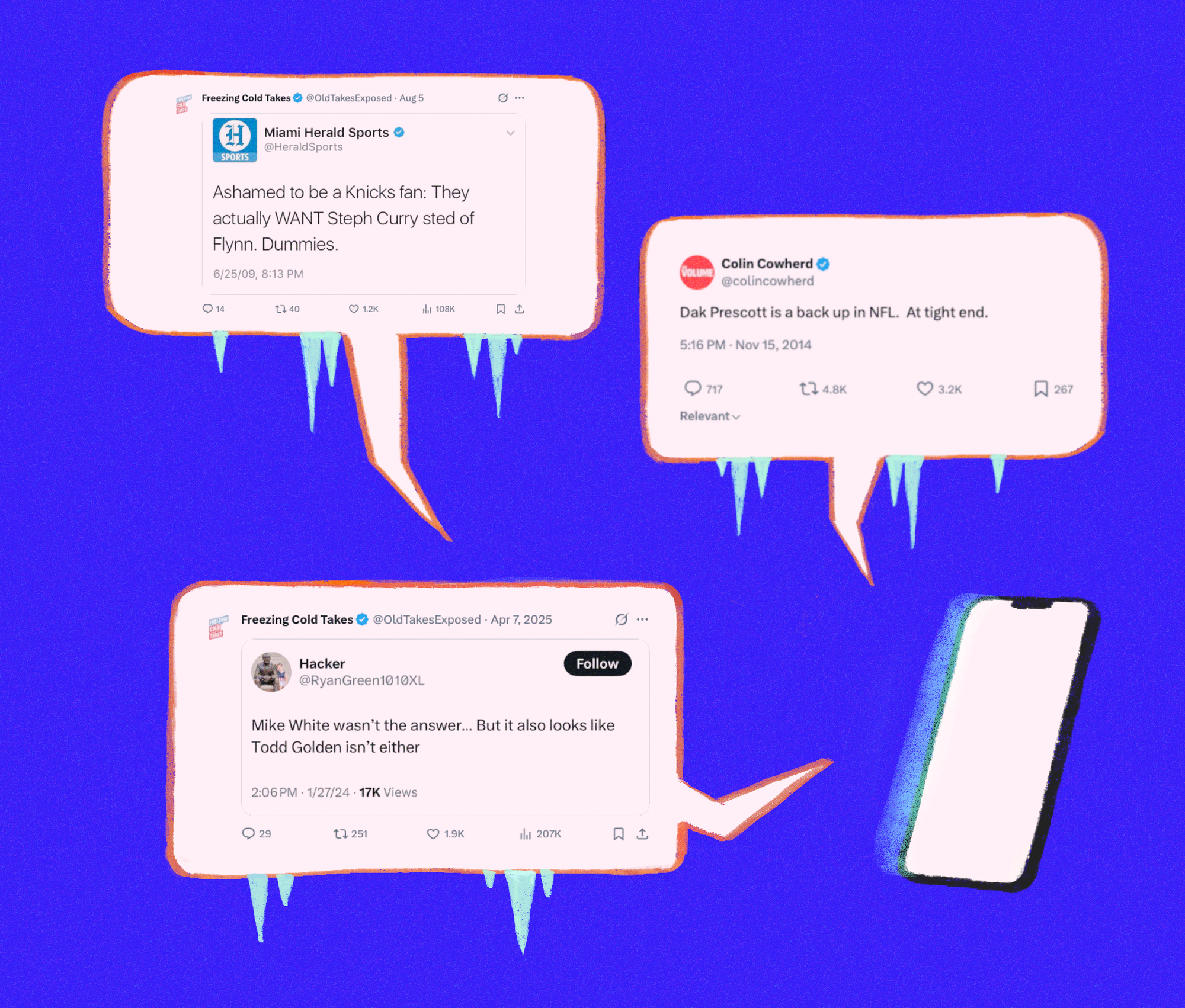
Among the most “frozen” have been Fox Sports hosts Skip Bayless and Cowherd, who Segal no longer targets because they became so prevalent, along with current Yahoo Sports columnist Dan Wolken. He, specifically, has become aware of the account, though he recognizes generating engagement, no matter how it comes, is a slice of his job.
“People are always watching what you say, as good or bad as that is,” Wolken said. “You live and die by engagement in this age. His account can serve you well, cycling things around. You never are just looking to say something that’ll get picked up there, though, at least. At some point, accuracy still needs to prevail.”
When Freezing Cold Takes first birthed into the Twitter cosmos, it was unique.
Segal would comb through the annals of the social media app looking for outlandish takes. This was back when the search feature on Twitter was functional, Segal said, so he had a relatively simple formula.
Anytime a game featured a notable result, or when one of a sport’s major characters struggled or exceeded expectations, he would back-search key terms surrounding his subject, looking to out anyone who once made a claim that butted with reality. Occasionally, he’d take on political subjects. But his best work always remained in football.
As Alabama played Mississippi State in 2014, a matchup of two top-five foes, Cowherd, then an ESPN Radio host, sat down with his phone at 5:16 p.m. The No. 1 Bulldogs were hurtling toward a 25-20 loss, and quarterback Dak Prescott had thrown three interceptions. Cowherd’s brain started clicking, and he dished out this beauty: “Dak Prescott is a backup in NFL. At tight end.”
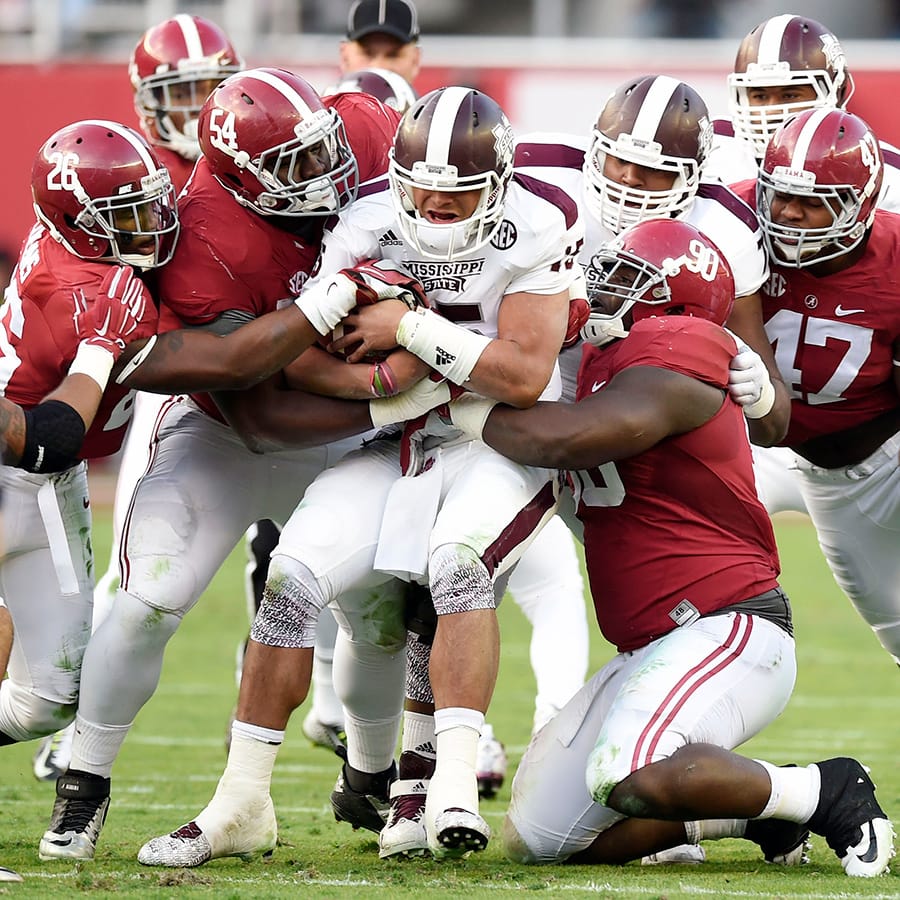
For the following years, the thought remained silently buried in his thousands of other thoughts. Then Prescott led the Cowboys to the playoffs in his rookie season, and Segal’s account, in its waking months, gave Cowherd’s two-year old clanker a second life. The account spiraled from there.
Segal was a healthcare transactional attorney and father of two, working nights to keep the account alive. He began promoting products and links from time to time, and eventually quit what he called his “lousy” job, turning Freezing Cold Takes into a career and writing books that feature the same exposé work. These days, his followers — all 639,000 of them — send in some significant number of the takes he reposts these days. The pace has slowed, too. When he first started the account, he’d find handfuls of fresh tomfoolery every night. You’d be lucky to see the account posting on a weekday night nowadays.
“Those are school nights,” he said. The real crux of his evolution offers a bit more delicacy.
Over time, he came to feel what he was doing was its own form of the “hot take” culture that’d swallowed, chewed and spit out sports consumption as he knew it. With every post, he was feeding into this sphere.
“It’s just hard to grapple with,” he said. “Everyone is so inclined to say something. Any engagement eggs them on. And this definitely offers engagement.”
None of that means he’s stopping just yet. The machine keeps galloping in millions of views and billions of dollars, and anyone who wants a slice of the output must maintain pace. Yet when he sits down each evening, hundreds of DMs eagerly filling his inbox with suggestions for his next culprits, the mind wanders.
Some of the takes soon to be frozen, he thinks, are being reported to him by those firing the original thoughts themselves.
“At that point,” he said, “I’m not sure what this world has become.”